When Good News Calls Us to Move
Disclaimer: Nothing in this blog post is intended to be considered medical or mental health advice or treatment. It’s written from the perspective of the author’s lived experience and reflects personal views expressed with the intent to encourage and share hope.
Have you ever been in the wrong place at the wrong time, through no fault of your own?
It happened to the children of Israel when they were exiled from Jerusalem to Babylon for seventy years. Some of those children may have grown up never really knowing the God of Israel for themselves. They may have heard other explanations for everything good or bad that happened around them. Others likely were brought up with instruction, but it was taking place in a foreign land with different laws and customs of the people around them.
But God was still God–even in exile.
Even in Babylon.
Even when His people were away from the place they knew as home.
The children had not done wrong, and God was going to bring them back home and let them get to know Him for themselves.
Favor in enemy territory
The king of Judah, Jehoiachin, did not necessarily lose every sign of his title or royal treatment when the Hebrew people went into captivity. Historical records and scripture show that he received provision, food, and a measure of honor while he was in Babylon. He was also included in the direct lineage of Jesus.
That is something worth noticing.
There was divine discipline involved in Israel’s exile, and there is much more to read and study about that on your own time. But it’s remarkable that even in enemy territory, there was still evidence of God’s mercy, preservation, and favor.
God spared people.
God kept His promise.
God was still writing a story.
We can remember this about our own lives too.
Sometimes we find ourselves in places we did not choose, seasons we did not expect, or circumstances we would not have written for ourselves. Yet even there, God can provide, protect, teach, and preserve.
The grief of exile
Even with evidence of provision, captivity was still painful.
Psalm 137:1-6 (NKJV) gives us a glimpse of the sorrow the people carried:
“By the rivers of Babylon,
There we sat down, yea, we wept
When we remembered Zion.
We hung our harps
Upon the willows in the midst of it.
For there those who carried us away captive asked of us a song,
And those who plundered us requested mirth,
Saying, “Sing us one of the songs of Zion!”
How shall we sing the Lord’s song
In a foreign land?
If I forget you, O Jerusalem,
Let my right hand forget its skill!
If I do not remember you,
Let my tongue cling to the roof of my mouth—
If I do not exalt Jerusalem
Above my chief joy.”
There was weeping, memory, and displacement. There was a deep ache of being away from the place that had meant worship, identity, covenant, and belonging. The temple had been burned. The city–invaded. There had been battle, death, captivity, grief, and confusion.
Any building burning down is painful–but this was not just any building.
This was the temple.
For Israel, it was central to worship, community, history, and national life. Its destruction was devastating, humiliating, and disheartening.
Remembering the promise
During the exile, a new class of scribes helped preserve and teach what God had said. Many had gone into Babylon during the first wave of aristocratic exiles, and they wanted to make sure the people did not forget God’s promise.
The captivity would not last forever. God had said His people would return. The scribes and prophets knew it was coming. They had been reading, studying, remembering, and believing. They had hope, and they wanted God’s people to have hope too.
We can imagine the encouragement:
“One day you will be free to go home.”
“One day you will leave this place behind.”
“One day the temple will be rebuilt.”
“One day we will return.”
That was good news.
But good news can still feel disruptive when people have grown comfortable in the place God is calling them to leave.
When freedom feels disruptive
Many of the people in Babylon had built lives there.
To them, Babylon may have simply felt like life. So when talk of returning began, some may have felt anxious.
Sometimes a place of captivity can begin to feel familiar. Enemy territory can become comfortable because God has been merciful enough to sustain us there. But provision in a hard place does not always mean we are meant to stay there forever.
Sometimes God provides while we are there, and then He calls us forward when it is time to go.
The decree to return
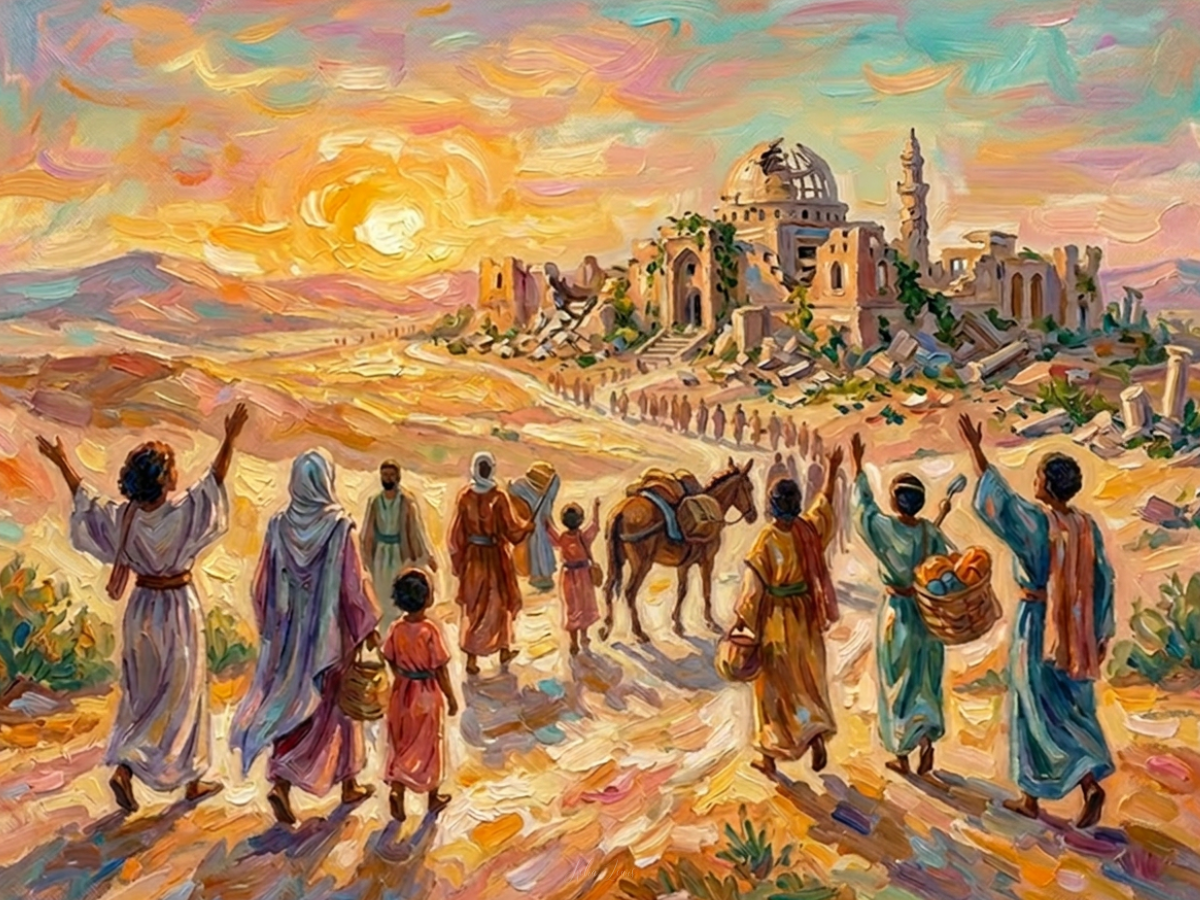
When Cyrus, king of Persia, took over Babylon and decreed freedom for the Israelites, they were allowed to return home.
That was good news!
Those who recognized the decree as God’s mercy and fulfillment of His promise found the opportunity to return was something to celebrate.
They were going back to the land of promise to rebuild and to worship.
They were going back to remember who they were…
The thankful remnant
Some returned to old patterns, and when Ezra saw it, he was deeply grieved.
But there were still those who were thankful and faithful to continue working on rebuilding the temple, for example. They listened and obeyed God’s prophets.
There is always a thankful remnant who want to do what is right no matter what is going on around them. Not merely because of history, what others suffered, or because someone told them they should. But because they want to do right in their hearts.
They did not know Christ the way we do now, but we do.
Those of us who have been reborn in Christ have been given the mind of Christ. We are invited to remember who we are in Him and let that remembrance shape how we live.
In Christ, we are not powerless to old patterns.
We are not without wisdom, help, or direction.
We are called to remember who we are and respond accordingly.
When good news challenges us
People will not always say what we like to hear.
Sometimes what they say will challenge us, call attention to character, or reveal where we have grown comfortable in something God wants to free us from. That is why we need discernment. We test what we hear, measure it by scripture, or look at the fruit. We ask God for wisdom. We should not reject a message simply because it challenges us.
Sometimes God sends truth to help free us from captivity, strongholds, patterns, or attachments that no longer line up with Him. Other times, that means we may need to let go of something that has been meaningful, familiar, prosperous, gifted, or beloved in its current form or season.
That can be difficult, but when God calls us forward, there is grace to keep going.
Do not stop on the road
If the people who left Babylon had stopped along the road and said, “This is too traumatic. This is not what I hoped for. I am staying here and starting over my own way,” it would not have been the same as returning to Israel and living in the beautiful way God intended.
There may have been understandable emotions along the way.
Fear.
Grief.
Uncertainty.
Exhaustion.
Questions.
But the road was still leading somewhere. Freedom, return, and restoration was good news.
Sometimes what God uses to lead us into freedom may feel disruptive at first. It may require movement, letting go, courage, or trusting Him beyond what is familiar.
Not every disruption is destruction.
Sometimes it is deliverance.
Beautiful Feet Bring Good News
Isaiah 52:7 (NKJV) says:
“How beautiful upon the mountains
Are the feet of him who brings good news,
Who proclaims peace,
Who brings glad tidings of good things,
Who proclaims salvation,
Who says to Zion,
‘Your God reigns!’”
Let’s be like the people who rejoice when we hear good news, even when it is unexpected and potentially disruptive.
It’s something to celebrate!
Yes, freedom may require movement, courage, or leaving behind what became familiar. But if God is leading, the movement is not punishment. It is mercy.
Let’s bless the people who bring us good news.
Let’s thank God for truth, even when it challenges us.
Let’s thank Him for mercy, even when mercy asks us to move.
Let’s thank Him for His goodness, even when His goodness interrupts what we had grown used to.
Reflection
Take a moment to consider:
Have you ever experienced God’s provision in a place you were not meant to stay forever?
Is there an area of life where freedom sounds good, but movement feels frightening?
Have you grown comfortable in something God may be calling you to leave behind?
What would it look like to receive good news with gratitude, even if it also requires courage?
Where might God be inviting you to return, rebuild, remember, or keep moving forward?
Prayer
Lord, thank You for being faithful in every season, even in places I did not choose and circumstances I did not expect. Thank You for Your mercy, preservation, and favor, even when life feels unfamiliar or difficult.
Help me recognize good news when it comes from You. Help me not to reject truth simply because it challenges me, interrupts me, or asks me to move. Give me discernment to know what is from You, humility to receive correction, and courage to walk forward when You open the door.
If I have grown comfortable in something You are calling me out of, help me trust You more than familiarity. If I have been afraid of what restoration might require, remind me that Your plans are good and Your presence goes with me.
Make me thankful. Make me willing. Make me attentive to Your voice.
Help me receive Your mercy with joy and keep going with You.
In Jesus’ name, amen.
Closing Thoughts
Good news is still good, even when it surprises us.
Freedom is still good, even when it requires movement.
Restoration is still good, even when rebuilding takes time.
Sometimes God’s mercy does not look like staying where things feel familiar. Sometimes His mercy looks like an open door, a call to return, and the courage to begin again.
So when good news comes, may we have hearts ready to receive it.
May we be thankful enough to move, and may we keep going with God, even when the road requires faith.